
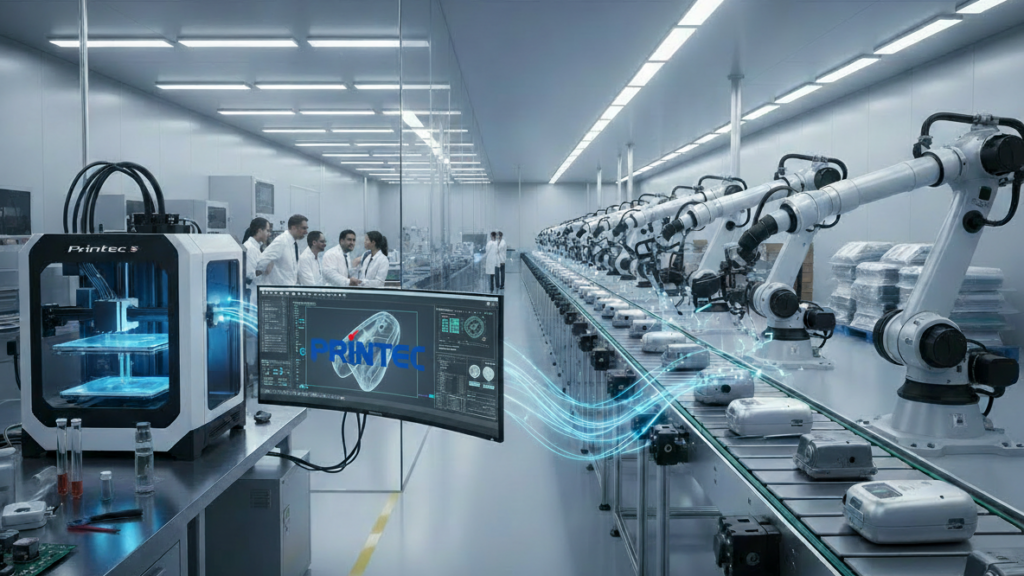
Prototype to production medical devices require more than functional prototypes. Prototype to production medical devices depend on manufacturability, repeatability, and process control.
In medical devices, that difference can determine whether a program launches smoothly or stalls under cost overruns, validation delays, and quality concerns.
Many early stage prototypes perform well in controlled environments.
They demonstrate concept viability. In many cases, those prototypes help secure funding. They also impress stakeholders.
But production is where the real test begins. Learn more about Printec’s medical device interface solutions.
Prototype to Production Medical Devices and the Prototype Illusion
Prototypes are often built with flexibility. Engineers adjust materials on the fly. Engineers assemble prototypes manually. Tolerances are interpreted generously. Small imperfections are acceptable because the objective is proof of concept.
However, production does not offer that luxury.
Once a device enters regulated manufacturing, every layer, adhesive, conductive path, and assembly step must be repeatable. It must withstand scrutiny. It must hold up not once, but thousands or millions of times.
What works in a lab setting does not automatically translate to a stable production process.
Prototype to Production Medical Devices Require Design for Manufacturability
The most successful programs treat manufacturability as a design requirement, not a later stage consideration.
This means asking early questions such as, “Can this layer stack be aligned consistently at volume?” “Are the selected materials compatible with validated process controls?” “Can the assembly method support repeatability under production pressure?” “Will tolerances hold across multiple shifts and batches?”
When engineers and manufacturing teams collaborate early, many downstream issues disappear before they begin.
For procurement leaders, this early alignment reduces risk. It protects timelines. It stabilizes cost projections.
Documentation Is a Bridge, Not a Formality
Transitioning from prototype to production requires disciplined documentation.
Controlled drawings, validated work instructions, material traceability, and defined inspection criteria create the bridge between engineering intent and manufacturing reality. Validated processes should align with ISO 13485 quality management system requirements.
Without this structure, variability increases. As a result, yields drop and quality investigations multiply.
With it, production becomes predictable.
Supplier Involvement Changes Outcomes
One of the most overlooked success factors in medical device manufacturing is early supplier engagement.
By contrast, manufacturing partners brought in after design freeze are often limited to reacting.
However, early supplier involvement allows them to contribute insights on materials, process controls, assembly methods, and long term scalability.
Moreover, this does not reduce engineering control. Instead, it strengthens it.
Procurement leaders also benefit. Early alignment provides better visibility into cost drivers, capacity planning, and potential supply constraints.
Scaling Without Breaking the System
Scaling from pilot runs to volume production introduces stress into any manufacturing system.
Teams must maintain material consistency.
In addition, teams must keep process parameters stable.
Inspection systems must detect deviation before it escalates.
The transition requires more than capacity. It requires process maturity.
As a result, teams that plan for scalability from the beginning experience smoother ramps and fewer surprises.
A Practical Perspective
Moving from prototype to production is not simply a phase change. It is a mindset shift.
It requires discipline. It also demands humility. Most importantly, teams must recognize that what works once must work reliably every time.
Manufacturable medical devices are not just engineered. They are built on systems that support precision, documentation, validation, and repeatability.
When design, manufacturing, and procurement align early, production becomes less about correction and more about execution.
In regulated industries, that difference matters.


